

Is giftedness just an IQ of 130+, or is it something more? This is a common and important question. According to modern, scientifically-backed models, the answer is clear: giftedness is much more than a single number.
One of the most insightful frameworks for understanding this is the Delphi Model of Giftedness. It offers a holistic view that considers a gifted individual in their total personality and in connection with their environment, moving far beyond a simple test score. This guide will simply and clearly explain the core components of this insightful model, breaking down its structure into easy-to-understand parts.
To understand this broader perspective, let’s start with the model’s own powerful definition of a gifted individual.
Experts in the field collaborated to formulate a comprehensive description of what it means to be gifted. The Delphi Model defines a gifted person as follows:
A gifted person is a quick and clever thinker, who can handle complex issues. Autonomous, curious, and driven by nature. A sensitive and emotional person. Intensely alive. He or she takes pleasure in creating.
The rest of this guide will break down the key terms in this definition ‘autonomous’, ‘sensitive’, ‘driven’, and more into the model’s structured components. The model organizes these characteristics into two main categories: our inner world and how we interact with the outer world.
The Delphi Model is structured around two sets of characteristics: three that describe the internal world of the gifted person, and three that describe their interaction with the external world.
These first three components-Being, Thinking, and Feeling-form the internal foundation of the gifted personality. They describe the fundamental inner workings of the individual.
| Component | Core Trait | What This Means for a Gifted Person |
| Zijn (Being) | Autonomous | They are internally driven to form their own conclusions. They will stand by their own judgment until a demonstrably better alternative is presented to them. |
| Denken (Thinking) | Highly Intelligent | Their thinking is analytical, pattern-seeking, and capable of operating on multiple tracks and levels simultaneously (often described as ’thinking in matrices’). With a large associative capacity, their thought process fluidly alternates between divergent (exploring many possibilities) and convergent (finding a single best solution) modes. This is the aspect an IQ test measures, but it doesn’t capture the whole dynamic picture. |
| Voelen (Feeling) | Richly Nuanced | Their emotional world is incredibly colorful, detailed, and interconnected. The intensity can sometimes be so overwhelming that they may need to shut down to cope. |
The next three components: Willing, Doing, and Perceiving, describe how the gifted person’s inner world moves outward and engages with their environment.
| Component | Core Trait | What This Means for a Gifted Person |
| Willen (Willing) | Driven & Curious | They have a strong desire to learn and discover things, but on their own terms. They are persistent and can easily enter a state of ‘flow’ when engaged in a topic. |
| Doen (Doing) | Creation-Oriented | They have a constant drive to create, whether it’s tangible (art, inventions) or mental (ideas, stories, structures). Crucially, the right environment is needed to facilitate this, and “doing” is not a mandatory condition for giftedness. |
| Waarnemen (Perceiving) | Highly Sensitive | Their nervous system processes information with exceptional sharpness and detail. This is linked to neurological differences, such as having more, thinner, and faster nerve endings and more active synapses, allowing their brain to be active in many areas at once. The result is that all their senses are always on high alert, taking in information with incredible nuance and intensity. It is critical to note, however, that not every highly sensitive person is gifted. |
Now that we’ve seen the six core building blocks, let’s explore the dynamic qualities that emerge when they all work together.
Some of the most recognizable characteristics of gifted individuals are not single traits, but the result of the interplay between all the previously mentioned components. The model identifies four such emergent qualities.
Bringing all these pieces together, we can now see the complete, multi-faceted picture the Delphi Model paints.
The primary value of the Delphi Model is that it moves beyond a simple IQ score to see the gifted individual as a whole, dynamic person. It acknowledges the deep inner world, the active engagement with the outer world, and the powerful qualities that arise from their interaction.
This integrated view is perfectly captured by the model’s official definition, which serves as the ultimate summary:
A gifted person is a quick and clever thinker, who can handle complex issues. Autonomous, curious, and driven by nature. A sensitive and emotional person. Intensely alive. He or she takes pleasure in creating.
Understanding this model can be a positive and powerful step in personal development and self-awareness, offering a richer and more complete language for what it means to be gifted.
Will you read more about giftedness and Acceptance and Commitment Therapy? Read and buy mij book: Had ik dit maar eerder geweten over ACT & hoogbegaafdheid.
Wil je hoogbegaafdheid als verrijking zien? Investeer in coaching. Hoe?
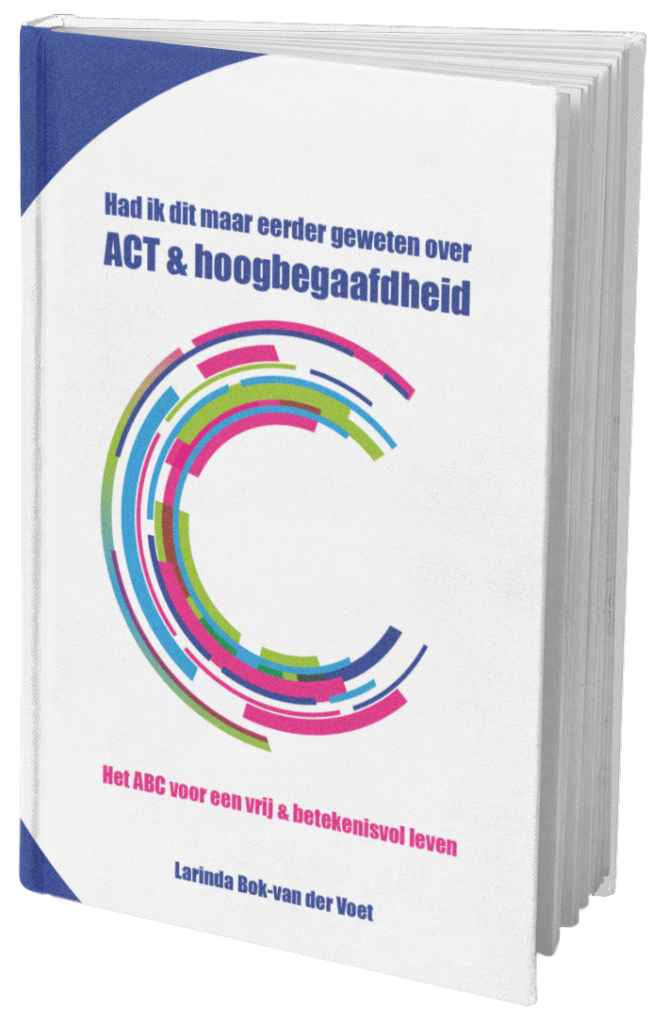
Als je je wilt verdiepen in de zelfbeeld- en persoonlijkheidsontwikkeling van mensen met kenmerken van hoogbegaafdheid, zelf betekenis wilt geven aan je leven of als je hulpverlener bent en je cliënten meer wilt leren over hoogbegaafdheid, dan is dit boek een waardevol instrument.